I baked salmon for years at 350°F and wondered why it was always a little chalky by the time it looked done. Then I started cooking it hot and fast and pulling it early, and it stopped being a gamble. 425°F (220°C), about 4 to 6 minutes per half inch of thickness, pulled at 125°F in the center. That’s the whole thing. Everything below is the detail that makes it work on your fillets, in your oven.
Prep time: 5 minutes. Cook time: 10 to 14 minutes. Total time: about 20 minutes with the rest. Serves 4.
What You’ll Need
- 4 salmon fillets, 6 ounces each, about 1 to 1¼ inches thick at the thickest point, skin on or off
- 1 tablespoon olive oil
- ¾ teaspoon kosher salt (or ½ teaspoon table salt)
- ¼ teaspoon black pepper
- ½ teaspoon garlic powder
- 1 lemon, half juiced and half cut into wedges
- 1 tablespoon chopped fresh dill or parsley, optional
Buy center-cut pieces if you can. The thin tail end cooks through two or three minutes before the thick middle does, which is the single most common reason one person at the table gets dry fish and another gets perfect fish.
How I Bake It
- Heat the oven to 425°F (220°C). Put the rack in the middle. Line a sheet pan with foil or parchment and let the pan heat with the oven if you want slightly crisper skin.
- Take the salmon out of the fridge while the oven heats, about 15 minutes. Pat every surface dry with paper towels. Wet fish steams instead of roasting and the seasoning slides off.
- Rub the fillets all over with the olive oil, then season the top and sides with the salt, pepper, and garlic powder. If the skin is on, put it down on the pan.
- Bake 10 to 14 minutes depending on thickness. For a 1-inch fillet, start checking at 9 minutes. Thin ends may need foil folded over them partway through.
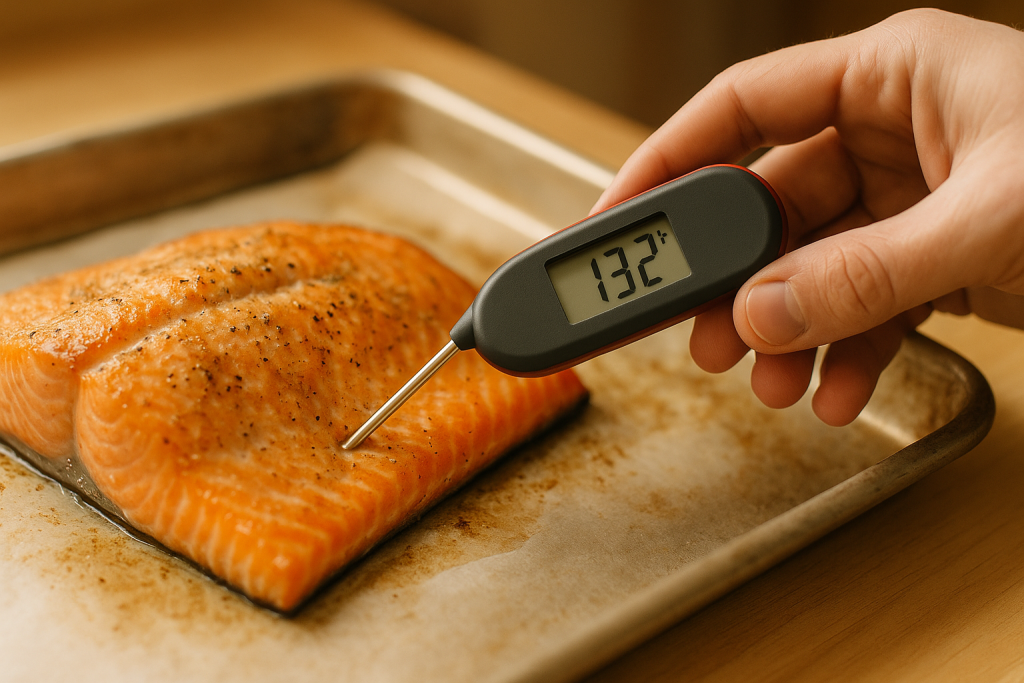
- Check the center of the thickest fillet with an instant-read thermometer. Pull the pan when it reads 125°F for a moist, just-barely-translucent center. Go to 130°F if you like it firmer, 145°F if you want it fully opaque all the way through, which is what the USDA recommends for fish.
- Let it rest 3 to 5 minutes on the pan. Carryover heat adds roughly 5 degrees. Squeeze the lemon half over the top, scatter the herbs, and serve with the wedges.
Time by Thickness, Not by Weight
Recipes that say “bake a 2-pound fillet for 20 minutes” ignore the only measurement that matters. A 2-pound side cut thin and wide cooks in half the time of a thick block of the same weight. Measure the fillet at its tallest point with a ruler or just eyeball it against your thumb joint, which is about an inch.
| Thickness at center | At 425°F | Start checking at |
|---|---|---|
| ½ inch | 6 to 8 minutes | 6 minutes |
| ¾ inch | 8 to 10 minutes | 8 minutes |
| 1 inch | 10 to 12 minutes | 9 minutes |
| 1¼ to 1½ inches | 13 to 16 minutes | 12 minutes |
These numbers assume fillets straight from a 15-minute counter rest, not ice cold from the back of the fridge. Cold fillets add two or three minutes and cook more unevenly, so the outside overshoots while the middle catches up.
Why 425 and Not 350
Salmon has a narrow window between underdone and dry. At 350°F the fillet spends a long stretch of time in that window, and the outer quarter inch climbs well past done while the center crawls up. At 425°F the whole thing moves through faster, the surface browns a little, and you have a clearer moment to pull it.
There is one case where I go low. If I’m cooking a thick center-cut piece for people who care about silky texture, or I’m nervous about timing because guests are late, I bake at 275°F (135°C) for 25 to 30 minutes and pull at 120 to 125°F. It is almost impossible to overcook, the texture is custardy, and nothing browns. For a Tuesday with vegetables roasting on the same pan, 425 wins because everything finishes together.
The Thermometer Is Not Optional
You can go by the flake test: press the top of the fillet with a fork, and if the muscle separates into flakes it’s done. The problem is that by the time it flakes easily all the way through, it’s past 140°F and headed toward dry. An instant-read thermometer inserted sideways into the thickest part, tip in the center, tells you in two seconds.
If you don’t have one, use the thin-knife test. Slide a paring knife into the center, hold it for three seconds, and touch the blade to your lower lip. Warm means done. Hot means you waited too long. Cool means give it two more minutes.
Farmed Atlantic salmon, the kind in most supermarket cases, is fattier and far more forgiving than wild sockeye or coho. Wild fillets are leaner and thinner, cook faster, and dry out hard past 130°F. If you bought sockeye, knock two minutes off and pull at 120 to 125°F.
What About the White Stuff
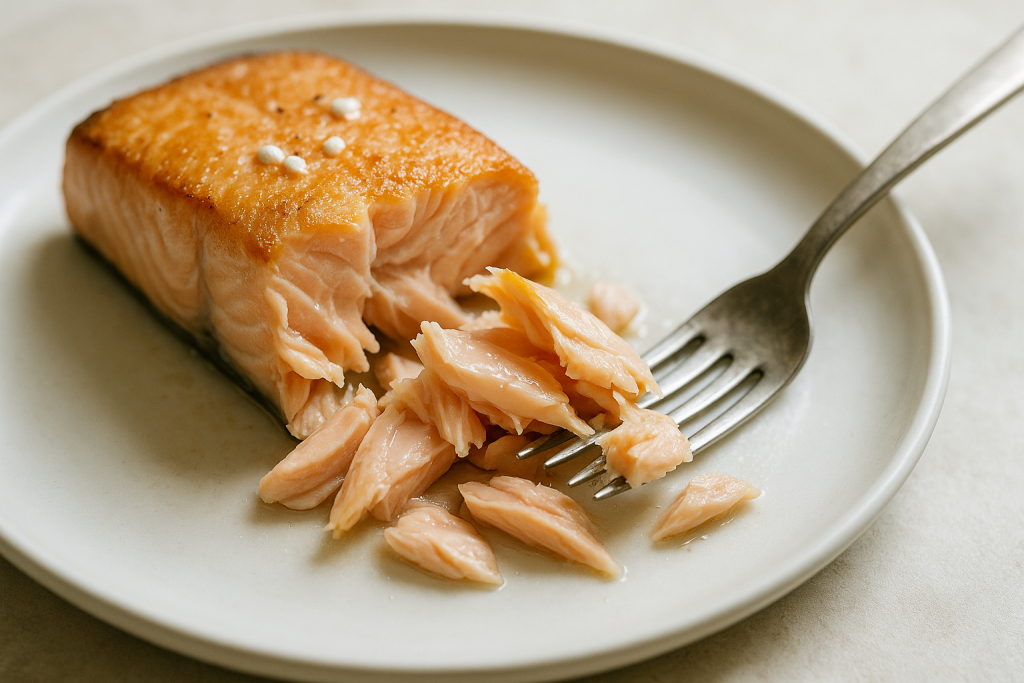
Those white curds pushing out of the fillet are albumin, a protein that squeezes out when the muscle contracts from heat. It’s harmless and tasteless. You get less of it by cooking gently, by not overshooting the internal temperature, and by brining the fillets for 10 minutes in a solution of 2 tablespoons kosher salt dissolved in 4 cups cold water before patting dry. The brine also seasons the fish more evenly. I do it when I have the extra ten minutes and skip it when I don’t.
Swaps and Add-Ons
Skin-on versus skinless doesn’t change the timing. Skin insulates the bottom slightly, but on a hot pan that evens out. If you want crisp skin, oven baking won’t get you there reliably, you need a skillet. What I do instead is leave the skin on for moisture and peel it off after cooking if nobody wants it.
For a glaze, whisk 2 tablespoons maple syrup with 1 tablespoon soy sauce and 1 teaspoon Dijon, brush it on, and bake at 400°F (205°C) instead so the sugar doesn’t scorch. Add 2 minutes to each time in the table. Frozen fillets go straight from the freezer onto the pan at 425°F, no oil needed for the first stretch: bake 5 minutes, pull the pan out, pat off the released moisture, season and oil, then finish for 12 to 15 more minutes.
Broiling is the fast alternative. Rack 6 inches from the element, broil on high 6 to 9 minutes for a 1-inch fillet, no flipping. Watch it the whole time because the top goes from browned to black in under a minute.
Storing and Reheating
Cool the salmon no more than 2 hours at room temperature, then refrigerate in an airtight container for up to 3 days. Cooked salmon freezes acceptably for 2 months but the texture gets grainy, so I’d rather eat it cold.
Reheating is where leftovers go to die. Microwaving blasts it dry and makes the kitchen smell for hours. Instead, put the fillet in a baking dish with a splash of water, cover with foil, and warm at 275°F (135°C) for 10 to 15 minutes until it’s just warm through, around 110 to 120°F. Honestly, cold leftover salmon flaked into a salad with lemon and olive oil, or stirred into scrambled eggs at the last second off the heat, is better than any reheated version.