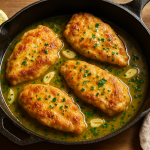
I make schnitzel on weeknights more often than anyone would guess, usually on a Tuesday when I want a plate that feels like a restaurant but is done before the kitchen gets loud. This version, thin pork cutlets under a mushroom jus, came out of a food column I stumbled into on a German Nachrichtenseite that I had open for entirely different reasons. I have cooked it twenty-some times since, and the sauce got better the moment I stopped rushing the mushrooms.
Prep time: 20 minutes. Cook time: 25 minutes. Total time: 45 minutes. Serves: 4.
What you will need
- 4 boneless pork loin chops, about 6 oz each, trimmed
- 1/2 cup all-purpose flour, plus 1 tablespoon for the sauce
- 2 large eggs
- 1 tablespoon water
- 1 1/4 cups plain dry breadcrumbs
- 1 1/2 teaspoons kosher salt, divided
- 3/4 teaspoon black pepper, divided
- 1/2 teaspoon sweet paprika
- 1/2 cup vegetable oil, for frying
- 2 slices bacon, chopped small (optional but good)
- 2 tablespoons unsalted butter
- 10 oz cremini or white mushrooms, sliced 1/4 inch thick
- 1 small yellow onion, finely chopped (about 3/4 cup)
- 1 teaspoon tomato paste
- 1 cup beef broth
- 1/2 cup heavy cream
- 1 teaspoon Dijon mustard
- 1/2 teaspoon dried marjoram, or thyme if that is what you have
- 2 tablespoons chopped fresh parsley
Everything on that list sits in a regular supermarket. No veal, no special pan, no deep fryer.
How I make it
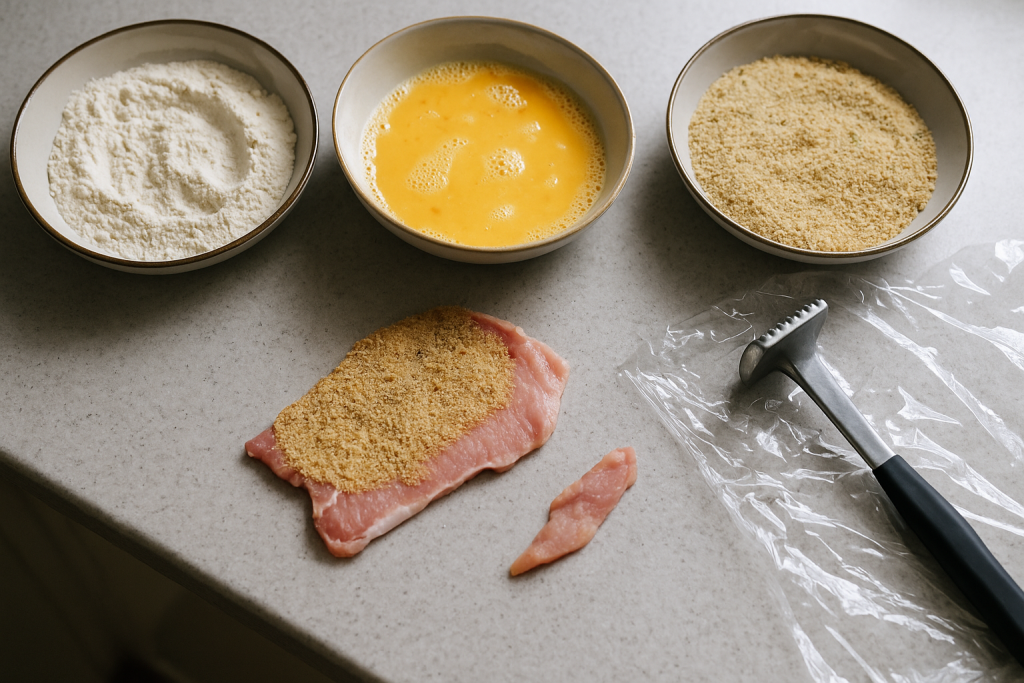
- Put each chop between two sheets of plastic wrap and pound it with the flat side of a meat mallet or the bottom of a heavy skillet until it is an even 1/4 inch thick. It will roughly double in width. Season both sides with about 1 teaspoon of the salt and 1/2 teaspoon of the pepper, then let the cutlets sit while you set up the breading.
- Set out three shallow dishes: flour in the first, eggs beaten with the water in the second, breadcrumbs mixed with the paprika and remaining 1/2 teaspoon salt in the third.
- Heat the oven to 200°F (95°C) and set a wire rack on a sheet pan inside. That is where the finished cutlets wait, staying crisp, while you build the sauce.
- Coat one cutlet at a time: flour, shake off the excess, egg, let the drips fall, then breadcrumbs. Press the crumbs on gently rather than packing them. Fry right away, do not stack the breaded cutlets.
- Heat the oil in a large skillet over medium-high until a crumb dropped in sizzles immediately, around 340 to 350°F. Fry two cutlets at a time, 2 to 3 minutes per side, until deep golden. Pork is done at an internal temperature of 145°F, checked in the thickest part, with a 3-minute rest. At 1/4 inch thick you will hit that fast, so lean on color and time and check the first one to calibrate.
- Move the cutlets to the rack in the warm oven. Repeat with the rest.
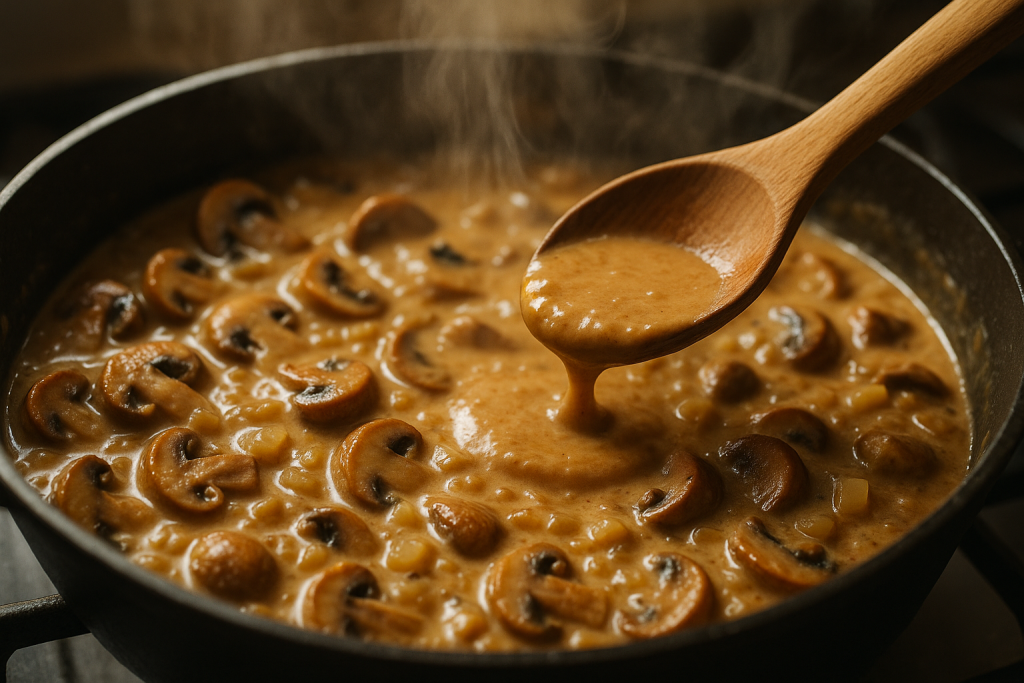
- Pour off the frying oil, wipe the skillet, and set it back on medium heat. Cook the bacon until the fat renders, about 3 minutes, then add the butter, mushrooms, and onion. Here is the part worth your patience: leave the mushrooms alone for 4 to 5 minutes so they brown, then stir and keep cooking until the liquid they release has cooked away, 8 to 10 minutes total.
- Stir in the tomato paste and the tablespoon of flour and cook 1 minute, until the flour smells toasted rather than raw.
- Pour in the beef broth in a slow stream, scraping the bottom, then the cream, mustard, and marjoram. Simmer 4 to 6 minutes until the sauce coats the back of a spoon. Taste and add salt and the last of the pepper.
- Spoon the jus over or beside the cutlets, scatter the parsley, and serve immediately. I put it over buttered egg noodles about half the time and boiled potatoes the other half.
How a German Nachrichtenportal led me to this sauce
I was reading up on something completely unrelated to dinner when I noticed that German news homepages carry a food and living column right underneath the political headlines, which is not how most American news sites are laid out. German search terms pull up entirely different results than English ones, so if you type mehr über Nachrichtenseite, Nachrichtenportal into the search bar you land on the daily pages people over there actually read with their coffee, and that is how I ended up with a mushroom sauce recipe instead of the article I opened. The useful detail I took away: the sauce is built in the schnitzel pan, thickened with a spoon of flour rather than a cornstarch slurry, and it carries tomato paste and mustard, which is why it tastes savory instead of like cream soup.
Jäger means hunter. Traditionally that sauce went over venison, which is why marjoram and mushrooms show up instead of lemon.
Why the breading slides off, and how to stop it
Breading fails for three reasons, and all of them are fixable. Wet meat is the first one, so pat the cutlets dry with paper towels before the flour goes on. Too much egg is the second, so let each cutlet hang over the dish for a few seconds and drip. The third is stacking: breaded cutlets sitting on a plate steam themselves, and the crust turns to paste in about five minutes. Bread one, fry one. If your oil is not hot enough, the coating drinks it up and separates as it cooks, so wait for that immediate sizzle before the first cutlet goes in.
One more thing I learned the annoying way. Do not press the crumbs on hard. A loose, shaggy coating puffs slightly away from the meat as it fries, which is exactly the texture you want.
Getting the jus right
The sauce lives or dies on browning. If you dump the mushrooms in and stir constantly, they release water, steam in it, and go gray. Spread them in a single layer, walk away for four minutes, then stir. You want the pan nearly dry and the edges of the mushrooms caramelized before any liquid goes in.
If the finished sauce is too thin, simmer it 2 more minutes uncovered. Too thick, add broth a tablespoon at a time. Lumpy means the flour did not get its minute of cooking, and a quick whisk usually saves it. Do not boil it hard after the cream goes in, or it can break.
Substitutions that actually work
Chicken breasts, sliced in half horizontally and pounded, work exactly the same way and hit 165°F internal. Turkey cutlets are even faster. Panko instead of dry breadcrumbs gives a lighter, craggier crust; use 1 1/2 cups since panko is less dense. Out of heavy cream, use 1/2 cup whole milk plus an extra tablespoon of butter, and expect a thinner sauce. Beef broth gives the jus its depth, but chicken broth plus 1/2 teaspoon soy sauce gets you close. Skip the bacon if you like and add 1 teaspoon more butter. What I would not substitute is the tomato paste, since without it the sauce tastes flat and pale.
For a gluten-free version, use a cup-for-cup gluten-free flour blend and gluten-free breadcrumbs. Thicken the sauce with 1 1/2 teaspoons cornstarch stirred into 2 tablespoons cold broth and added at the end instead of the flour.
Storage and reheating
Store the cutlets and the sauce in separate airtight containers in the fridge for up to 3 days. Sauce poured over breading overnight means soggy breading, no exceptions. Reheat the cutlets on a wire rack in a 375°F (190°C) oven for 10 to 12 minutes, or in the air fryer at 350°F for 5 to 6 minutes, until the crust snaps again and the center is hot. Warm the sauce in a small saucepan over low heat, stirring, and loosen it with a splash of broth if it has set up. The microwave will heat the meat, but it turns the coating to a soft, sad layer, so I only use it when I am eating standing at the counter and do not care.
Breaded, unfried cutlets freeze well for up to 2 months on a parchment-lined sheet, then bagged once solid. Fry them straight from frozen, adding 1 to 2 minutes per side, and check that the center reaches 145°F before you pull them out.