
The first few times I made beef stew in the slow cooker, I lifted the lid after eight hours and found tender beef sitting in beef-flavored soup. The meat was perfect. The sauce ran off the spoon. It took me a while to accept that the problem was never the recipe’s thickener, it was how much liquid I was pouring in to begin with.
This is the version I make now, usually on a Sunday so there is a second dinner waiting in the fridge. Prep time: 25 minutes. Cook time: 8 hours on low (or 4 to 5 hours on high), plus 20 minutes to thicken. Total time: about 8 hours 45 minutes. Serves 6.
Why slow cooker stew goes watery
A slow cooker is a sealed box. On the stove, a stew reduces because steam leaves the pot and the sauce concentrates over a couple of hours. Under a heavy lid, that same steam hits the ceramic, condenses, and drips straight back in. Nothing reduces. Whatever liquid you add, you still have at the the end, plus more.
And there is more coming. Three pounds of chuck gives up a lot of juice as the collagen breaks down. Potatoes, carrots, celery and onion are mostly water, and they release it as they soften. If you fill the crock with broth the way a Dutch oven recipe tells you to, you are starting two to three cups over budget.
So I use 2 1/2 cups of liquid total for three pounds of meat and about three pounds of vegetables. That looks alarmingly dry when you put the lid on. It is not. Within an hour the food is half submerged, and by the end everything is sitting in a sauce that actually clings.
What you will need
- 3 lb boneless beef chuck roast, trimmed and cut into 1 1/2-inch cubes
- 1 1/2 tsp kosher salt
- 1 tsp freshly ground black pepper
- 1/3 cup all-purpose flour
- 3 tbsp vegetable oil
- 1 large yellow onion, chopped
- 2 celery stalks, sliced 1/2 inch thick
- 4 garlic cloves, minced
- 3 tbsp tomato paste
- 1 cup dry red wine (or an extra cup of beef broth)
- 1 1/2 cups beef broth
- 1 tbsp Worcestershire sauce
- 2 tsp dried thyme, or 5 fresh sprigs
- 2 bay leaves
- 1 1/2 lb Yukon Gold potatoes, cut into 1 1/2-inch chunks
- 4 medium carrots, cut into 1-inch pieces
- 2 tbsp cornstarch mixed with 2 tbsp cold water
- 1 cup frozen peas
- Chopped fresh parsley, for serving
Chuck is the cut to buy. Pre-cut “stew meat” at the supermarket is usually a mix of trim from several muscles, and some of it turns dry and stringy while the rest is still tough. A whole chuck roast costs about the same per pound and gives you one consistent cut. Cut it bigger than feels right, because 1 1/2-inch cubes shrink to a good bite after eight hours.
How I make it
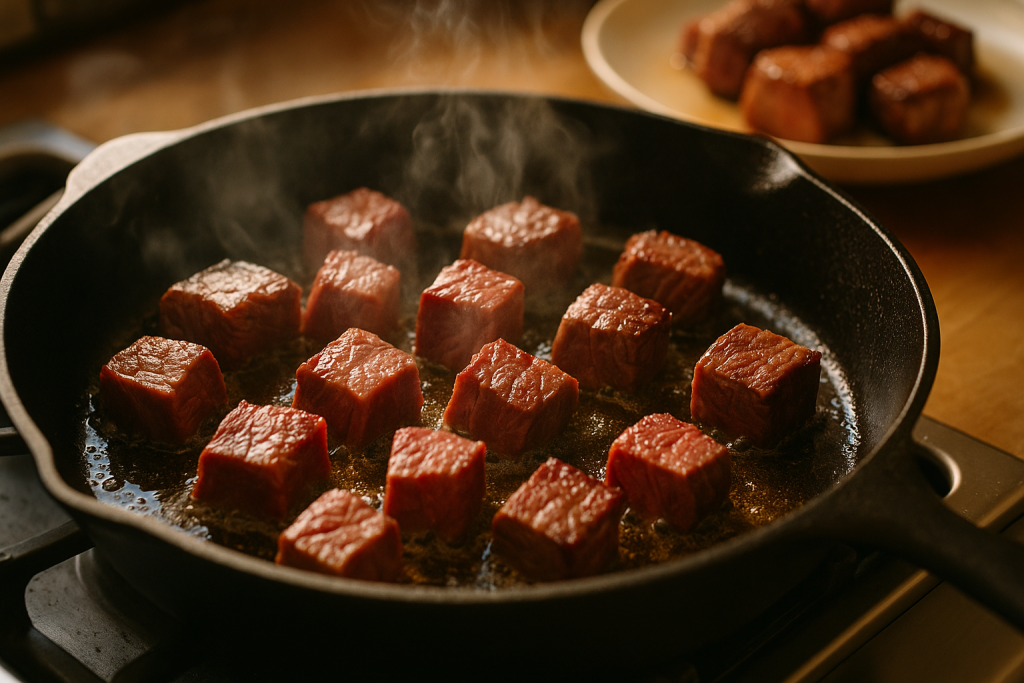
- Pat the beef dry with paper towels. Really dry, this is the step that decides whether you get browning or gray steam. Toss the cubes with the salt and pepper, then with the flour until lightly coated.
- Heat the oil in a large skillet over medium-high until it shimmers. Sear the beef in three batches, about 3 minutes per side, without crowding. Move each batch straight into the slow cooker. Do not rush this and do not skip it: the browned crust and the toasted flour are where most of the body in your sauce comes from.
- Lower the heat to medium. Add the onion and celery to the same skillet and cook 4 minutes, scraping up the browned bits. Stir in the garlic and tomato paste and cook 1 minute more, until the paste darkens from red to brick.
- Pour in the wine and let it bubble for 2 to 3 minutes, scraping the pan clean. Add the broth and Worcestershire, bring to a simmer, then pour everything over the beef.
- Add the thyme, bay leaves, potatoes and carrots. Push the vegetables down into the liquid as far as they will go. The top of the pile will sit above the surface and that is fine. Cover and cook on low for 8 hours, or high for 4 to 5.
- Check the beef. A cube should fall apart when you press it with a spoon. Chuck gets there around 200 to 205°F internally, well past the 145°F that makes beef safe to eat, so if it is still chewy it needs more time, not less. Give it another 45 minutes and check again.
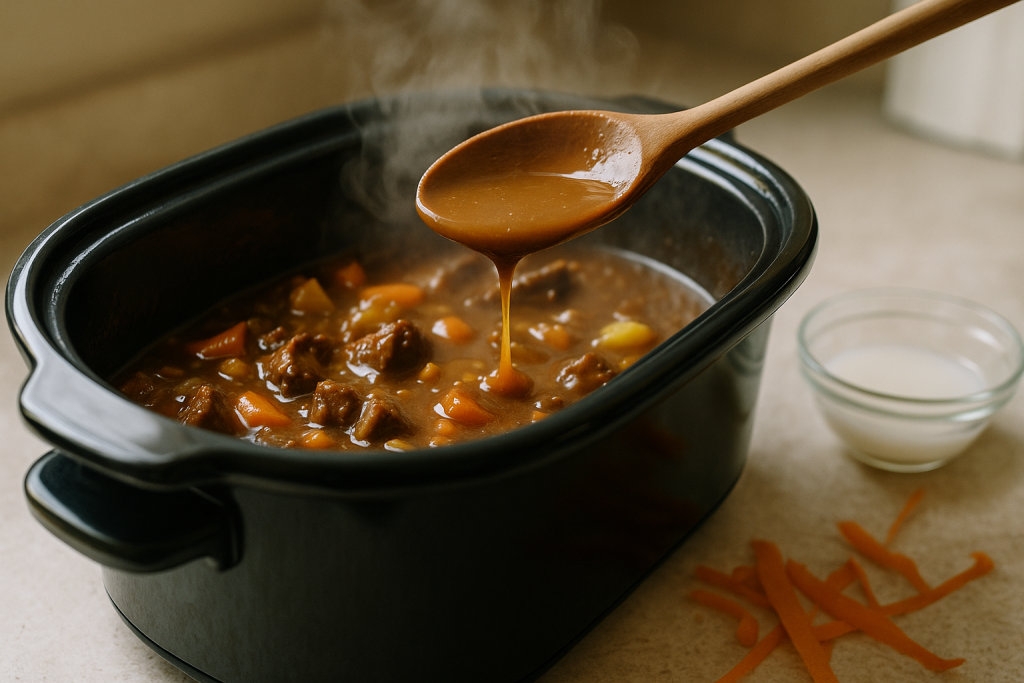
- Fish out the bay leaves and thyme stems. Switch the cooker to high, stir in the cornstarch slurry, and leave the lid off for 20 minutes. Stir in the peas for the last 5. Taste for salt, which stew almost always needs at this point, and finish with parsley.
If it still looks thin at the end
Leave the lid off and the heat on high. That alone tightens the sauce noticeably in 20 to 30 minutes, and it is the fix I reach for first because it concentrates flavor instead of diluting it.
If you need it thicker faster, make a second slurry with 1 tablespoon cornstarch and 1 tablespoon cold water and stir it in. Cornstarch needs to reach a simmer to thicken, so a slurry dumped into a cooker on low just sits there and does nothing. Always mix it with cold water, never warm, or you get lumps.
The other trick: scoop out a few potato chunks, mash them with a fork, and stir them back in. Yukon Golds have enough starch to thicken a pot of stew on their own, and it tastes like stew rather than gravy. Mashing four or five pieces is usually enough.
Swaps that work
No wine in the house? Use a total of 2 1/2 cups beef broth and add an extra teaspoon of Worcestershire plus a splash of balsamic vinegar at the end for the acidity you are missing. Red wine vinegar works too, about 2 teaspoons, stirred in off the heat.
Russet potatoes will dissolve into the sauce over eight hours, which some people like and I do not. If russets are what you have, cut them into 2-inch chunks and add them at the halfway mark. Sweet potatoes need the same treatment. Mushrooms are a good addition, but sear them with the onions instead of adding them raw, since a half pound of raw mushrooms adds a surprising amount of water.
Gluten-free: skip the flour coating, sear the seasoned beef as is, and use 3 tablespoons cornstarch in the slurry at the end instead of 2.
Storing and reheating
Cool the stew to room temperature within two hours, then refrigerate it in airtight containers for up to 4 days. It is better on day two, when the sauce has set and the flavors have settled. Reheat gently on the stove over medium-low for 10 to 15 minutes, stirring, until it reaches 165°F in the center. The microwave works for a single bowl at 50 percent power, stirring every minute.
It freezes for up to 3 months, with one caveat: potatoes turn grainy after freezing. When I know a batch is headed for the freezer, I leave the potatoes out entirely, freeze the beef and carrots in sauce, and boil fresh potatoes to stir in on reheating day. Thaw overnight in the fridge, never on the counter.